 GhArticles.com Every News in Detail
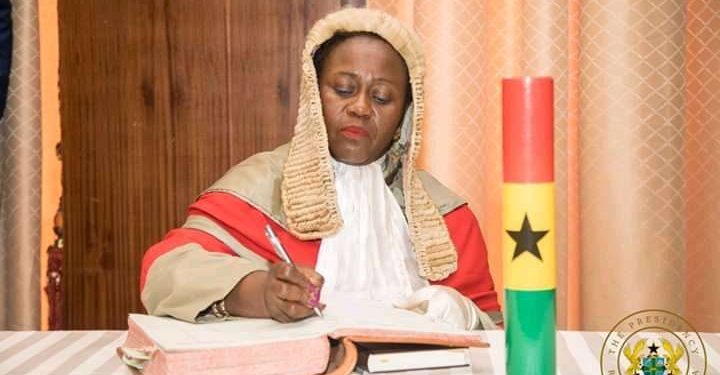
Chief Justice of Ghana, Gertrude Torkornoo, has filed a groundbreaking suit at the ECOWAS Court of Justice, demanding $10 million in compensation for what she describes as moral and reputational damage resulting from her suspension by President John Dramani Mahama.
This marks an unprecedented moment in Ghana’s judicial history, as it is the first time a sitting Chief Justice is challenging their suspension at an international tribunal. Justice Torkornoo’s legal action seeks to challenge the legitimacy of the process for her removal and raise concerns about violations of her fundamental human rights.
In the detailed legal filing, the Chief Justice argues that her suspension, which took effect on April 22, 2025, violated multiple provisions of the African Charter on Human and Peoples’ Rights, including:
Her right to a fair hearing (Article 7), citing that the investigative panel lacked independence and impartiality.
Her right to fair and satisfactory working conditions (Article 15), referencing the impact of the suspension on her professional duties.
Her right to dignity (Article 5), noting the public ridicule and reputational damage she and her family have suffered.
Her professional integrity, stating that the process has inflicted “immeasurable public ridicule” both locally and internationally.
The Chief Justice is not only seeking monetary compensation but is also asking the ECOWAS Court to issue formal declarations condemning the suspension as a breach of her rights. Additionally, she wants the court to invalidate the process currently underway in Ghana to remove her from office.
President Mahama’s decision to suspend Justice Torkornoo was based on Article 146 of the 1992 Constitution, which outlines the procedures for removing justices of the superior courts. The process involves an initial determination by the Council of State and the establishment of a committee of inquiry.
Justice Torkornoo previously attempted to stop the process through the domestic courts, but her injunction application was dismissed by the Supreme Court in May 2025. The core constitutional challenges remain unresolved.
Her move to the ECOWAS Court has drawn divided opinions. While some legal experts argue that domestic remedies should be exhausted first, others point out that ECOWAS Court precedents permit parallel proceedings if the issue is not before another international court.
Legal analysts say the outcome of this case could have far-reaching consequences not only for judicial independence and the separation of powers in Ghana but also for how international human rights instruments are applied to high-level governance cases across West Africa.


